Wednesday, December 22, 2021

KDIGO 2021- ANCA vasculitis management

 Check out the latest update in 2021 of treatment of ANCA vasculitis at KDIGO

1. Kidney biopsy is highly recommended in most cases

2. For induction- they recommend that steroids in combination with cyclophosphamide or rituximab be used for new onset AAV. 

3. For patients with GFR that is declining of crt >4.0mg/dl, there is limited data for rituximab based treatment. The combination of cyclo+ ritux can be used in that setting - RITUXIVAS protocol.
 
    4. When to do cytoxan vs rituxan?


5. Reduced dose steroids have shown similar results as high dose steroids( PEXIVAS trial)

6. Dosing for Rituxan and cyclophosphamide


7. Consider plasma exchange with crt >5.7 requiring dialysis or with rapid rise in crt and diffuse alveolar hemorrhage with hypoxemia or overlap syndrome with Anti GBM

8. Maintenance therapy


Sunday, December 19, 2021

In the News: WhatsApp in Onconephrology


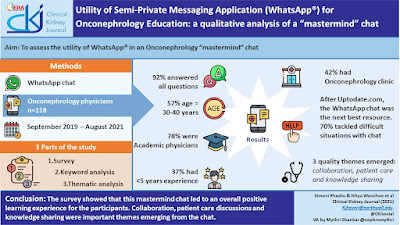
A recent study published looked at using a "mastermind" chat using WhatsApp for onconephrology discussion. This group was created using Whatsapp in 2019. Since then close to 100 members are part of an ongoing online discussion. This study evaluated the 2 years of chat content via a survey, keywords and a full qualitative thematic analysis.

1. The keywords showed the figure below- The bigger the font, the most commonly discussed topic. 


2. In terms of thematic analysis, the 3 common themes that emerged were: collaboration, case discussions and knowledge sharing.

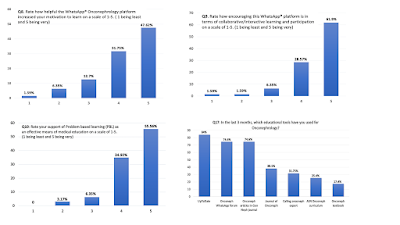
3. In terms of the survey, the key figure is below.  It is interesting that after uptodate.com, the chat was used by many for knowledge discussion and topic question answering. This is fascinating and could be because many of the topic experts and uptodate.com chapter writers were on this chat. 


Use of mastermind chats like this should grow in medicine. This allows for small subspecialty fields to have like minded individuals e-meet and discuss tough clinical challenges, share important knowledge and eventually collaboration for research. A recent paper on CDK4/6 inhibitors causing ATN was a result of collaboration led by this chat. 

Check out this amazing tweetorial by Prakash G on this.

Saturday, December 18, 2021

American Society of Onconephrology


We have come a long way in the last 13 years. The origins  of this field can be traced back to 2005 when the first book on this topic was released by Eric Cohen et al. The field of oncology has continued to rapidly evolve since then, and the advent of tyrosine kinase inhibitors, chimeric antigen receptor T-cell (CAR-T) therapy, and immunotherapy has further necessitated the development of this new subspecialty. Onconephrology has since become its own rapidly-growing subspecialty. As many of you know my passion for this field has been evident on my blog for the last decade. With the help of the amazing founding members team, this organization was created this fall of 2021.


The website is at https://www.ason-online.org/ and twitter( @onconephsociety)
The mission is to promote research, clinical activities, and education related to onconephrology. 

More specifically, the primary objectives of this society shall be to further the investigation of onco-nephrology and reach a better understanding of the basic mechanisms involved as follows:
By informal group discussion of material that is of cross disciplinary interest as it pertains to care of patients with kidney disease and cancer.
By exchange of ideas pertaining to clinical experiences and experimental research
By consideration of problems encountered in onco-nephrology research. 
By the promotion of good fellowship and mutual trust among members of this organization.
By fostering education and identifying gaps in knowledge as it pertains to onconephrology.

Membership will be soon available. Let's welcome the beginning of the next phase of this field in nephrology.

​


Friday, December 10, 2021

Topic Discussion: CDK4/6 inhibitors and the Kidney

Selective estrogen receptor inhibitors and aromatase inhibitors are the mainstay of therapy for hormonal receptor-positive (HR+) breast cancer; however, most metastatic HR+, human epidermal growth factor receptor 2-negative (HER2-) progress and acquire resistance to endocrine therapies. Cyclin-dependent kinase 4/6 inhibitors (CDK4/6 inhibitors) comprise a new class of drugs that overcome this resistance.  Three CDK4/6 inhibitors—palbociclib, ribociclib, and abemaciclib—have been approved for HER2-negative metastatic breast cancers, usually in combination with hormone therapy. 


Interestingly, the renal community has seen elevated serum creatinine associated with these agents. Several early trials of palbociclib and ribociclib did not describe the incidence of AKI, whereas clinical trials of abemaciclib have reported that up to 25% of patients experienced a rise in creatinine. In vitro studies of abemaciclib have shown that the drug and its major metabolites inhibit renal transporters like organic cation transporter-2, multidrug and toxin extrusion-1 (MATE-1), and MATE2-K, potentially leading to a reversible rise in creatinine without actually changing GFR. Cases have been described that show this pseudo-AKI. 

More recently, biopsy proven cases of acute tubular injury also have been noted- 6 cases with tubular and interstitial damage.

Finally, a search of the FAERs database revealed that, in addition to AKI, metabolic disturbances like hypokalemia, hyponatremia, and hypocalcemia may occur while on CDK4/6 inhibitors. Hyponatremia has been reported with ribociclib and with abemaciclib and grade 2 hypokalemia was reported in 20.8% of patients taking abemaciclib. 

In summary, the common renal associations with CDK4/6 inhibitors are

Pseudo AKI, ATI, hyponatremia, hypokalemia and hypocalcemia

Tuesday, November 23, 2021

KDIGO 2021- GN Management Guidelines: MPGN

 The recent KDIGO guidelines are here

One of the most important changes is getting rid of the MPGN1, 2 and 3 classification and using the novel pathophysiology based classification and recognizing that MPGN is a pattern of injury


The diagnosis of the C3GN and DDD is tough and requires the extensive assays and testing on complement cascade.


Treatment really depends on the cause.

For idiopathic causes of MPGN pattern of injury, consider a limited course of steroids
For RPGN of idiopathic cause, steroids + cyclophosphamide
For MPGN with low GFR< 30, supportive treatment only

For C3GN, and no signs of MGRS, and failed MMF and steroids, eculizumab should be considered


Monday, November 22, 2021

Topic Discussion: Pre eclampsia and APOL1

 This ASN 2021, I heard an interesting lecture and realized some novel associations with pre-eclampsia(PEC) and APOL1 gene mutations. 

Here are some interesting findings.

1. Black women have a higher risk of PEC their White counterparts.
2. Reidy et all showed that it is the FETAL not maternal APOL1 renal risk variant that is associated with PEC in Black women.

3. Some other studies showed that PEC was associated with the maternal G1 and not the G2 allele

4. In Blacks in Ohio, INFANT APOL1 genotype was associated with PEC

5. Recent study in AJKD, found that APOL1 kidney risk variants in Black mother and infant pairs of women of African American origin had higher risk of PEC compared to Haitian women. PEC was higher with maternal and fetal APOL1 genotype discordance, an effect driven by the African American mother-infant pairs. 


6. None of the published studies assessed if the mother’s APOL1 genotype conferred preeclampsia risk independently of the fetal APOL1 genotype, although in African Americans both the maternal and fetal APOL1 renal risk variants appear to increase risk if an APOL1 genotype discordance exists.

7. Experimental data support the hypothesis that APOL1 renal risk variants mediate preeclampsia. APOL1 levels, APOL1-derived peptides, and APOL1 autoantibodies have been linked to preeclampsia. Sedor's team showed that transgenic mice that expressed APOL1 using the nephrin promoter developed a pregnancy-associated phenotype characterized by hypertension, proteinuria, and seizures, which was more severe in transgenic animals with an APOL1 kidney risk variants transgene compared to reference. 

Overall, this is fascinating as we learn regarding the risk of PEC and APOL1 risk variants. It appears that fetal variants of the gene may be more important here.. the story continues to evolve... Stay tuned..

Thursday, October 28, 2021

KDIGO 2021- GN Management Guidelines: Infection associated GN

The recent KDIGO update 2021

Bacterial infection associated GN- 4 main types


Post infectious GN
Shunt nephritis
Endocarditis associated GN
IgA dominant infection related GN

All 4 of them usually have low complement levels.  No RCT for treatment
Antibiotics or surgical treatment for respective infections


Viral infection associated GN- 

Hep B- Hep B DNA >2000 IU/ml, need treatment with anti Hep B agent and no avoid immunosuppressive agents as can accelerate the viral infection.

HIV disease: HAART therapy is recommended for all HIVAN and HIVICK diseases.

Hep C associated GN:  A kidney biopsy should be performed in HCV-positive patients with clinical evidence of glomerular disease. Patients with mild or moderate forms of HCV-associated GN with stable kidney function and/or non-nephrotic proteinuria should be managed first with a DAA regimen. Patients with severe cryoglobulinemia or severe glomerular disease induced by HCV (i.e., nephrotic proteinuria or rapidly progressive kidney failure) should be treated with immunosuppressive agents (generally with rituximab as the first-line agent) and/or plasma exchange in addition to DAA therapies. Patients with HCV-related glomerular disease who do not respond to or are intolerant of antiviral treatment should also be treated with immunosuppressive agents.


All Posts

Search This Blog