Showing posts with label asn media center. Show all posts

Tuesday, September 27, 2022

Perspective: Interim report of ASN Task Force for Future of Nephrology 2022

 The ASN task force on the Future of Nephrology 2022 put out 10 important pointers for fellowship training. Here are the 10 pointers with my opinion on each next to it.


1. Enhance competency based Nephrology education: This is in line similar to COCATs in cardiology. 
I think this is a very important move as this will let us focus on the core topics in General Nephrology training. Overall, this is a win win for both fellows and programs

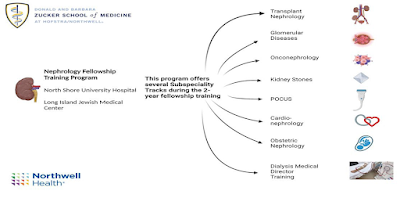
2. Individualize pathways for career goals: This is basically asking to create tracks so that each fellow can create a career niche. After basic general nephrology training, allow for time spent in various sub fields within nephrology( not an extra year of training). 
Personally, I am all for this one and have been promoting this at our center for last 6 years. This allows for selection of tracks and focus for each fellow. It makes their fellowship unique from the peers. Focused tracks can make this happen. At our center we do the following tracks and give a certificate for each graduate. But each track has requirements they have to fulfil under a small curriculum within a curriculum.  Yes, its time to just be creative over and over. 

3. Reconsider procedural training in Nephrology. Emphasis on removal of potentially placing of lines and performance of kidney biopsies. Instead, there should be focus on indications, knowledge of complications and if someone desires( individualized training), program should be able to offer the training. Emphasis on POCUS was mentioned.
This is the final straw for our procedures in nephrology but if you ask the fellows- most don't do it anyway post graduation- Its time for it to go. Smart Move by ASN. I don't think it should be required for ACGME and board exam to have done these procedures. Good focus on POCUS as we embrace the future. This is a win for fellows but not sure if a complete win for programs. Not all programs have faculty to teach POCUS. We need more faculty trained in POCUS to make this happen. Glad I learnt it from my fellow many years ago- truly has changed my practice.

4. Emphasize training in home therapies- Need more intensive training in PD and HHD.
This is a MUST for all. I think this is important for our patients and our trainees. A win for the fellows. Not a sure win for all programs as some programs may suffer due to lack of patients -- not their fault as its a system's problem at some centers. But this may raise the bar to make sure there is enough faculty who are comfortable to teach PD and HHD and enough volume. Not sure you need a third year for this but rather most fellows graduating should be able to comfortable prescribing and managing PD and HHD. Some fellows who want an academic career may want an extra year of training at specialized centers. 

5.Close gaps in current nephrology training. If there were gaps from the above 4 points, programs may need to partner with other societies to close those gaps.
I think this is a temporary solution. Eventually, this will evolve as most programs close the gaps

6. Promote well being of nephrology fellows. 
This was important and finally made it to a priority. This will help with burnout in our fellows. Working with NP/PA and restructuring programs will help with this matter. We must not forget our faculty and attending well being as we work on fellows well being. Neither should suffer.

7. Prioritize diversity, equity, inclusion and health care justice
I think this is extremely important. We need more diverse applicants and applicant pool in Nephrology. Diversity brings ideas and promotion of our field forward. 

8. Foster interprofessional practice.
This is important and our recent ASN Kidney News sept 2022 issue really highlights this. We are a kidney care team- all should work together. 

9. Ensure interdisciplinary practice. Working closely with cardiology, oncology, hepatology and other fields in medicine is critical for our training. 
This is a given but almost forgotten. Working with our colleagues closely will be important to foster collaboration and programs to help trainees for both sides. A classic example of this is centers that have created nephro-hospitalistscardio-renal services etc. 

10. Inspire lifelong learning
This is aspirational. This may happen but may not happen. This is individualized but if the program can create venues, programs to continue ongoing learning- this would be very helpful. 


Overall, I applaud the entire ASN workgroup on this venture!


Friday, January 21, 2022

In the News: Nephrology training in the Pandemic Survey by ASN

 A survey done of renal fellows training during the pandemic has now been published.

The link is here https://data.asn-online.org/reports/fs_21/

Some key take home messages of this overall positive survey on our field.

1. Over 80% of fellows felt their program had successfully maintained education and conferences via video and over 80% felt that they were ready for independent practice. 

2. Over 80% of fellows saw patients virtually as outpatients and a small number during the inpatient rotations.

3. Burnout was high though during the pandemic ( women more than men)

4. Overall employment perceptions improved from years prior

5. More fellows RECOMMENDED nephrology as a field this time around( the silver lining of the pandemic)

6. Where are fellows going?  Nearly 90% start a clinical position, and 2% or so did general internal medicine. Remaining were industry, other fields and joint fields with nephrology

7. Median starting salary was 200,000 US$. Interestingly, IMGs got a higher base pay compared to USMGs. NO difference in female vs male salaries( a big win for Nephrology)


8.  Income guarantees ( by far ) was the most common incentive for the job they took, followed by MOC and CME support, signing bonuses, career development resources. 

9. Most fellows chose nephrology during residency. Sadly only 6% want to do a career in research. 


10.  And on a final note, during their training, only 14% placed dialysis catheters and did renal biopsies. This speaks volumes and perhaps its time we move on from this unfortunate loss of skills. Let's focus on training our fellows on knowledge and improving therapeutics. 

Tuesday, October 9, 2018

ASN 2018 Fellows in Training Bowl( FIT) Bowl


Every year since 2012, ASN has done the FIT bowl to inspire fellows to compete and learn nephrology in a fun and competitive way. Usually, there are 2 teams of various fellows from different fellowship programs mixed competing for the winning spot. First round is usually Case Based debates( Mystery case) run by Hitesh H Shah and myself and then a fun filled Jeopardy round with James Simon and team. 

This year, there is going to be some changes. It will move to a 2 days process to allow for more game time. The competition will start on Thursday, October 25, 2018 from 10:30am-12:30pm in the Scientific Exposition floor, Hall A of the San Diego Convention Center.
The overall competition schedule is as follows:

THURSDAY, OCTOBER 25, 2018
10:30 a.m. – 12:30 p.m. PDT
FRIDAY, OCTOBER 26, 2018
Semi-Finals ( Case-based debates rounds)
10:30 a.m. – 11:30 a.m. PDT
Finals
11:30 a.m. – 12:30 p.m. PDT ( Jeopardy based Nephron Challenge)

The winners of the competition will be recognized at the plenary session on Saturday, October 27, 2018 from 8:00 a.m. – 9:30 a.m. PDT in Hall D of the Convention Center. 

Fellowship programs have volunteered to compete.  Come support this fellows event on both days!
It should be a lot of fun, especially for residents, med students and fellows.

Wednesday, June 6, 2018

Detective Nephron: Next adventure

Check out the next adventure of Detective Nephron as he tackles a case of hyperkalemia in the June issue of ASN Kidney News 2018

http://onlinedigeditions.com/publication/?i=501369#{%22issue_id%22:501369,%22page%22:14}

Image result for detective

Sunday, November 5, 2017

Nephrology on the rise, Positive trials, Positive job market!!

Nephrology really took an amazing turn this Kidney week in 2017. Positive trials, positive news and amazing things are happening for everyone involved in renal care.

First and foremost, the high impact clinical trials in 2017 ASN Kidney week revealed several positive trials.

The REPRISE study showed the impressive promise of use of tolvaptan in late stage ADPKD.  The liver related side effects were minimal. Hope to see this in clinical practice soon

The MENTOR trial that compared cyclosporine to rituximab for PLA2R membranous GN showed rituximab to be non inferior with lower rate of adverse effects. Looks like rituximab will be changing the treatment paradigm in membranous GN treatment.

Is contrast nephropathy dead? No not really. A randomized controlled trial showed that intra arterial contrast studies are more likely to cause contrast nephropathy compared to intra-venous, but both did have a incidence of contrast nephropathy.

A novel agent called QPI-1002 showed significant promise in decreasing AKI post CABG in high risk population.

Bardoxolone Methyl Improved GFR Measured by Standard Inulin Clearance: The TSUBAKI Study in Japan. The return of Bard!!

Another positive note: The GW-ASN fellows survey showed an upswing in job opportunities for our fellows in training. https://www.asn-online.org/education/training/workforce/

Finally, social media nephrology Guru Joel Topf wins Robert Narins award with an amazing video presentation done by ASN.


Tuesday, May 30, 2017

ASN Robert G Narins Award for 2017 goes to Blogger, educator Joel Topf

The Robert G. Narins Award by ASN honors individuals who have made substantial and meritorious contributions in education and teaching. This award is named for Robert G. Narins, who is also the first recipient of the award.

Dr. Narins' contributions to education and teaching started in 1967 from chairing for eight years the ABIM's Nephrology Board and working on the ACP's Annual Program Committee. His contributions to education in the fields of fluid-electrolyte and acid-base physiology are prodigious and well-recognized.  Dr. Narins was also involved in the creation and planning of many ASN educational programs during Renal Week and throughout the year, including: Board Review Course and Update, one and two day programs at Renal Week, Renal WeekEnds, and NephSAP.

Prior Award winners of this award are( from ASN website)

·    2015 Mark L. Zeidel, MD, FASN
·    2014 Stuart L. Linas, MD, FASN
·    2013 Mark E. Rosenberg, MD, FASN
·    2012 Donald E. Kohan, MD, PhD, FASN
·    2011 Agnes B. Fogo, MD
·    2010 Barry M. Brenner, MD
·    2009 Burton D. Rose, MD
·    2008 Mitchell L. Halperin, MD
·    2007 Richard J. Glassock, MD
·    2006 Robert G. Narins, MD

This year marks a landmark in this award as it’s being presented to Joel Topf, MD.

Image result for joel topf

While all other educators followed a conventional track for teaching and educating, Joel’s contribution to nephrology education has been very unique and different.  Here is what Joel has accomplished in the last 10 years!
1.       Creation and maintaining the Precious Body Fluids Blog with educational material that spans from electrolyte disorders to AKI
2.       The best acid base book written in Nephrology as a “resident”. This is by far the easiest book to understand acid base disorders.
3.       Co creation of the first ever academic journal blog- AJKD blog
4.       Creation of Nephmadness since 2013 ( first ever online game in Nephrology) with educational material that spans all parts of renal medicine
5.       Creation of NephJC( the first and most successful online journal club that meets every 2 weeks)
6.       Co creation of DreamRCT( how to propose and create a dream RCT that we need in nephrology competiton)
7.       Creation of Nephrology Social Media Collective Internship to train trainees, and faculty on become social media experts to improve medical education
8.       Teaching and promoting social media education in nephrology
9.       Showcasing how twitter can be used in nephrology education at it’s best! (https://twitter.com/kidney_boy)
10.   Several teaching awards at his local institution

Most important of all: He has inspired and trained many young and old teachers/and educators due to his passion for nephrology!
Way to go Joel and congrats!

Friday, February 24, 2017

ASN Online Journal Chat on onconephrology topic

Dear Onco-Nephrology and Transplant Community members,

On Monday, February 27 at 9:00 pm EDT the Onco-Nephrology community is hosting a journal chat on immune checkpoint inhibitors and all ASN members are invited!

Here is how you can participate: 
  1. Join the Onco-Nephrology Community, if you haven't already
  2. Set your community notification settings for the Onco-Nephrology Community only to “Real Time”
  3. Read the Topic Summary on line or listed below.
  4. Watch your inbox on Monday for the discussion to start and participate in the chat
If you have any questions about setting up your notifications, please contact ASN Communities Associate Zach Cahill

Summary of topic by Mona Doshi, MD

The goal of any course of cancer treatment is to prevent and/or kill future growth of malignant cells. Sometimes this can be challenging as some cancer cells gain the ability to “trick” the immune system into thinking the cancer cells are normal healthy cells. Doctors are seeing promise in a group of drugs called immune checkpoint inhibitors, which actually “open up the immune system” and allow the immune system(T-cells) to recognize and attack the cancer. Two recent reviews published in early 2017 have summarized the effects of immune check point inhibitors (ICI) on the kidney.
We shall be discussing NEJM letter published on Jan 12th 2017. While effective in most cancer patients, this course of treatment has been less successful in kidney transplant patients because activating the immune system causes the patient’s body to start rejecting their donor kidney.  Five prior cases published in the literature of renal transplant patients getting PD-1 inhibitors have resulted in rejection. The rejections were mostly seen in PD-1 inhibitor based therapy compared to CTLA-4 therapy. In addition, the 2 cases of liver transplant where these agents were used and 1 case of heart transplant didn’t lead to a rejection episode.  But in the renal transplant patients, 5 cases have now been reported of leading to acute cellular and antibody mediated rejection when PD-1 inhibitor was administered. In a recent case correspondence in NEJM Jan 12th 2017 issue, the authors observed during the treatment of a patient living with cancer who had a kidney transplant that the combination of steroids and sirolimus (an immunosuppressant that has anti cancer properties),  could prevent a patient’s body from rejecting the organ during  cancer treatment with ICI.
In the case the authors observed the treatment of a 70 year-old Caucasian male who received a kidney transplant in 2010 and recently underwent treatment for small bowel cancer which had spread to the liver. The patient was given prednisone, a steroid, and sirolimus prior to incorporating an immune checkpoint inhibitor (nivolumab). The steroids were started 1 week prior to the starting of nivolumab and continued at a tapered regimen as mentioned in the manuscript to prevent the immune mediated reaction seen in prior cases. Steroids didn’t hinder the shrinkage of the cancer. There was significant response in tumor burden (as shown in the appendix) and the serum creatinine remained stable (as shown in appendix). There were no clinical or immunological signs of rejection.
In this forum discussion, as nephrologists, we can try to come up with ways to answer few questions for the oncologists.
1. What is the best treatment strategy for ICI induced AIN (dose, duration of steroids)?
2. What is the best preventive strategy for patients who have had ICI induced AIN and need to continue the targeted therapy?
3. Given the above single case report, can the above mTOR inhibitor+ steroid strategy be employed in all transplant patients receiving PD-1 inhibitors?


If you have questions about the content of the chat, contact any of the ONC leaders.
Sincerely,

The Onco-Nephrology Leadership Team

Wednesday, May 25, 2016

First article from 1966 that inaugurated the ASN

The field of Nephrology is not that old. ASN is going to be celebrating the 50th year of creation of the American Society of Nephrology this Fall 2016. I wanted to share the first article ever published in 1966 introducing ASN to the world. It was recently linked in ASN Kidney News.  Worth a read.
Even back then in 1966, a plea was made for early referrals for CKD, and not wait too long...

Check it out here...

Saturday, June 27, 2015

ASN and NBPAS

Recent changes to MOC and criticism of ABIM, where does nephrology stand.  Bold move by ASN to interview with founder of the new organization National Board of Physicians and Surgeons(NBPAS).

I think starting this discussion now is so critical. Hats off to Tod Ibrahim and ASN to take this initiative as we need to redefine that is reasonably priced and truly looks at clinical work that we do.

http://asn-online.org/media/podcast.aspx?p=kidneynews&e=2015_06_25_Teirstein.mp3


Thursday, May 28, 2015

ASN Fellows Survey on Workforce 2015

Nephrology Workforce Annual Fellows report in 2015 is being collected by ASN via a survey. 

This survey, being  performed by colleagues at Geoorge Washington University, will be very useful to understand our workforce related concerns. A prior survey done in 2014 had some alarming results.

See link below at ASN website.
http://asn-online.org/education/training/workforce/home.aspx

The Workforce committee of ASN has spent the last 5 years or more attempting to draw conclusions about fellowship trends and workforce needs from fragmented information. This is one of our few opportunities to gather good data and have it analyzed by those with expertise in healthcare workforce studies.

I think the fellows in the USA should take this opportunity to help out the field of Nephrology. You should try to  must  complete the survey you received from ASN. 


Sunday, March 15, 2015

ASN- KSAP First installment

Nephrology Self-Assessment Program (NephSAP) has served for twelve years as a strategy for nephrologists to keep knowledge up-to-date and earn both CME credits.

ASN has recognized a need for material that covers basic principles of clinical nephrology that would be appropriate for individuals who are studying for the In-Training/In-Service examination or preparing for the American Board of Internal Medicine (ABIM) examination in the subspecialty of Nephrology. To this end, the concept of the Kidney Self-Assessment Program (KSAP) was developed.

KSAP is similar to having a Q bank for board preparation and re certification exams.
Please visit and see what you all think

This was must needed and well intended

http://asn-online.org/education/ksap/

Sunday, November 9, 2014

ASN Nephrology Fellow's Events 2014

Welcome reception: Nov 12th: 6-7PM
Marriott Downtown, Grand Ballroom, Salon H

Fellows In Training Bowl( Mystery Case Debate): Nov 14th 2-3PM
Convention Center, Room  119A

Fellows In Training Bowl( Jeopardy game Nephrology Challenge): Nov 14th 3-4PM
Convention Center, Room  119A

Meet the Experts Session Nov 15th  9:30AM - 10:30AM( Meeting the ASN Award Winners)
Convention Center, Hall D

Fellows Forum Nov 15th 10:30-11:30AM
Convention Center, Room 203

Fellows Poster Discussion Section Nov 15th 2-3PM
Convention Center, Room 112

Sunday, November 2, 2014

ASN 2014 Abstracts

ASN abstracts 2014 are now online and available for review.
Posters on demand will also have online posters for viewing soon as well.

For those interested in Social media and education in nephrology, few special sessions being held this year


1. Tweets, likes and Blogs: How to use social media for your patients and your benefit.Nov 13, 1030-12:30PM

2.Boost your teaching skills to become a contemporary nephrology educator. Nov 14, 2-4PM
3. Case Based Debates ( Fellows in training bowl)- Mystery case competition Nov 14, 2-3PM
4. Nephrology fellows jeopardy- Nov 14, 3-4PM

Monday, May 12, 2014

William and Sandra Bennett Clinical Scholars Program and Nephrology Education

William and Sandra Bennett Clinical Scholars Program and Nephrology Education

Congrats to the American Society of Nephrology (ASN) on creating the first ever grant for clinician educators and for a career in Nephrology education.  This will inspire more clinicians, Nephrology educators  to complete their scholarly activities and perform research in Nephrology education. It is called the William and Sandra Bennett Clinical Scholars Program. 

ASN and the ASN Foundation for Kidney Research is now accepting applications for the new William and Sandra Bennett Clinical Scholars Program. Applications go live on May 19th 2014. The deadline to apply is Friday, June 27 at 4:00 p.m. ET.

The program provides $50,000 per year for up to two years to support aspiring Nephrology educators to conduct a project to advance all facets of Nephrology education and teaching.
Applicants may submit a proposal that examines any aspect of the Nephrology education, such as curricular reform, innovations in education, new education methods, evaluation of new assessment tools for competency-based learning and assessment, professional development, or professionalism.

Additionally, recipients are encouraged to complete a formal (such as earning a master’s degree in medical education) or semiformal education (such as Stanford University School of Medicine’s Faculty Development Program for Clinical Teaching) during the ASN Foundation funded years.

All interested clinician educators with great ideas- apply for this amazing opportunity to advance your career and the field of Nephrology. 


For more information about this exciting program or to apply, please visit the ASN website

Monday, March 31, 2014

Kidney MAPS: Volunteer opportunity

Kidney MAPS (Mentoring and Assessment Program for Students) was established by the American Society of Nephrology (ASN) to promote interest in nephrology careers through student-organized community screening programs that identify people at risk for diabetes and hypertension in medically under-served communities. Each chapter is supported by practicing nephrologists who volunteer their time and mentor medical students. 

The goal of Kidney MAPS is to recruit and mentor the next generation of nephrologists early in their careers by showing students the risk factors for chronic kidney disease, the effects of kidney disease on public health and the increasing need for medical professionals to help combat it.
Currently, ASN supports student chapters at Emory University, Indiana University and the University of Louisville.

In addition, as a part of Kidney MAPS, the ASN and chapters headquartered in the Kidney Week host city partners with the American Kidney Fund to host a Kidney Action Day screening event to kick-off Kidney Week each year. In 2013, the Emory University Kidney MAPS Chapter partnered with AKF to screen nearly 250 patients.


For more information about the Kidney MAPS program and learn how to establish chapter at your institution, please contact Lisa Bryan at lbryan@asn-online.org. 

Monday, March 24, 2014

Kidney Treks: Physiology training for medical students

Kidney TREKS (Tutored Research and Education for Kidney Scholars) was established by the American Society of Nephrology (ASN) in 2013. 

In its second year, the program fosters interest in nephrology careers and biomedical research through a week-long research course retreat and long-term mentorship program.
This year, 25 medical students and 5 graduate students will attend an “Origins of Renal Physiology” course for students at the renowned Mount Desert Island Biologics Laboratory (MDIBL) in Bar Harbor, ME.

The course enhances first-year medical students' understanding of basic physiological concepts through hands-on experiments in a research laboratory. Organized around several modules that examine all aspects of kidney function, such as water homeostasis, salt homeostasis and secretion, acid/base homeostasis, glomerular function, and personalized medicine and genetics, the course offers opportunities for practicing classical experiments using model systems (toad, zebrafish, roundworm, shark, Xenopus oocyte) combined with modern molecular techniques.

After the course, ASN matches each student with a nephrologist-mentor who will interact with them over the course of medical school training, graduate school or postdoctoral fellowship.

Hope programs like these will enhance interest in nephrology among our medical students. 


For more information about Kidney TREKS program, please visit the ASN website

All Posts

Search This Blog