Showing posts with label anti GBM. Show all posts

Saturday, April 29, 2023

Topic Discussion: Atypical anti GBM disease


We are aware that circulating anti-GBM antibodies are directly pathogenic in anti-GBM disease. However, about 10% of patients with anti-GBM disease do not have circulating anti- GBM antibodies.


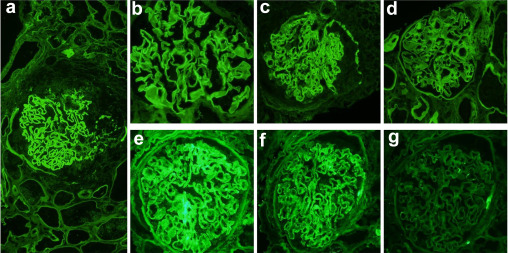
Atypical anti-GBM disease is considered when patients have linear IgG deposition along the glomerular basement membrane without anti-GBM antibodies in the circulation.

Atypical anti-GBM disease comprises 8% to 12% of all anti-GBM disease cases. About 2% to 8% of patients with anti-GBM disease have negative serology despite rigorous testing.

Pathogenesis:

(1)different composition of antigen/epitope: a)Antibodies against the NC1 domain of other alpha chains like alpha1, alpha4, or alpha5 chains of type IV collagen or to the NC1 domain of alpha345 hexamers, b)Linear epitopes of the collagenous domain, or C)entactin

(2)different affinity of antibodies: a) high-affinity autoantibodies trapped in the kidneys and present with low titer in circulation, or (b)Autoantibodies could also have a low affinity for the substrate in the assay

(3) different types of antibody: a). the dominance of different IgG subclass such as IgG4 or IgG1 and frequent presence of IgG2, b) presence of IgA or IgM dominance which is not exactly atypical anti-GBM diseases in terms of clinical/pathological presentation

Pathology: (i) Lack diffuse crescentic and necrotizing glomerulonephritis, (ii). Light microscopy heterogenous: mesangial and/or endocapillary proliferative GN, MPGN, FSGS, mesangial sclerosis; and glomerular endothelial changes resembling TMA are common

Monotypic atypical anti-GBM disease: Monotypic Ig deposits along the GBM are increasingly observed to cause a disease pattern similar to atypical anti-GBM. Needs further study to confirm if it is a form of MGRS?

Prognosis: Kidney dysfunction is usually milder and evolves slower than classic anti-GBM disease; however, presentation as RPGN has also been reported. Proteinuria and nephrotic syndrome are more frequent than classic anti-GBM disease.

Treatment: is individualized and typically consists of immunosuppressive agents used to treat classic anti-GBM disease or monotherapy with renin-angiotensin-aldosterone blockers

Check out this review


Friday, June 1, 2012

KDIGO Guidelines for Glomerular Diseases: ANTI GBM disease


ANTI GBM disease based GN
KDIGO guidelines from Kidney International

1. Initiating cyclophos + steroids + plasmapheresis in all anti GBM GN except those who are on dialysis at presentation and have 100% crescents in a good sample and do not have pulmonary hemorrhage( 1B)
2. No maintenance therapy is needed for anti GBM GN( 1 D)
3. Defer kidney transplantation after anti GBM GN until anti GBM antibodies have been undetected for minimum of 6 months ( not graded)

For full details see: http://www.nature.com/kisup/journal/v2/n2/pdf/kisup201227a.pdf

Tuesday, May 3, 2011

CLINICAL CASE 36, ANSWERS AND SUMMARY

Which of the following regarding Anti GBM disease in elderly is true?

This entity is non existent in the age> 65   0%
Anti GBM disease in the elderly is more of a female predominance
15% 
Anti GBM disease in the elderly is more severe than in the younger patients
17%
Anti GBM disease has more severe lung hemorrhage than younger patients
10%
Anti GBM disease has a significantly higher proportion of positive ANCA results in this age group
57%

Good work all. Majority got this one right. Recently in AJKD this topic was reviewed looking especially at cases in the elderly.  This entity does exist in the elderly and fairly common. It has more of a male predominance and it is actually LESS severe than when it happens in younger patients.  The lung disease is also LESS severe. The correct answer hence is the last one- it does occur a lot of time concurrently with a positive ANCA blood test in this age group. This group also has lower proteinuria at presentation and higher GFR on presentation. 

Ref:

All Posts

Search This Blog