Special post by
Lakshmi Kannan, MBBS, MD,
Department of Nephrology, Pikeville Medical Center
Adjunct Faculty, University of Pikeville Kentucky College of
Osteopathic Medicine
Kentucky, USA
Reference is here

Special post by
Lakshmi Kannan, MBBS, MD,
Department of Nephrology, Pikeville Medical Center
Adjunct Faculty, University of Pikeville Kentucky College of
Osteopathic Medicine
Kentucky, USA
Reference is here
1. Enhance competency based Nephrology education: This is in line similar to COCATs in cardiology.
I think this is a very important move as this will let us focus on the core topics in General Nephrology training. Overall, this is a win win for both fellows and programs
2. Individualize pathways for career goals: This is basically asking to create tracks so that each fellow can create a career niche. After basic general nephrology training, allow for time spent in various sub fields within nephrology( not an extra year of training).
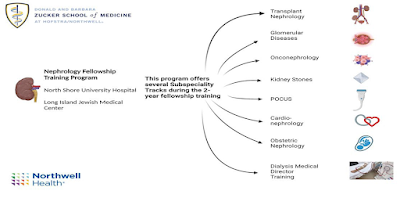
Personally, I am all for this one and have been promoting this at our center for last 6 years. This allows for selection of tracks and focus for each fellow. It makes their fellowship unique from the peers. Focused tracks can make this happen. At our center we do the following tracks and give a certificate for each graduate. But each track has requirements they have to fulfil under a small curriculum within a curriculum. Yes, its time to just be creative over and over.
4. Emphasize training in home therapies- Need more intensive training in PD and HHD.
This is a MUST for all. I think this is important for our patients and our trainees. A win for the fellows. Not a sure win for all programs as some programs may suffer due to lack of patients -- not their fault as its a system's problem at some centers. But this may raise the bar to make sure there is enough faculty who are comfortable to teach PD and HHD and enough volume. Not sure you need a third year for this but rather most fellows graduating should be able to comfortable prescribing and managing PD and HHD. Some fellows who want an academic career may want an extra year of training at specialized centers.
5.Close gaps in current nephrology training. If there were gaps from the above 4 points, programs may need to partner with other societies to close those gaps.
I think this is a temporary solution. Eventually, this will evolve as most programs close the gaps
6. Promote well being of nephrology fellows.
This was important and finally made it to a priority. This will help with burnout in our fellows. Working with NP/PA and restructuring programs will help with this matter. We must not forget our faculty and attending well being as we work on fellows well being. Neither should suffer.
7. Prioritize diversity, equity, inclusion and health care justice
I think this is extremely important. We need more diverse applicants and applicant pool in Nephrology. Diversity brings ideas and promotion of our field forward.
8. Foster interprofessional practice.
This is important and our recent ASN Kidney News sept 2022 issue really highlights this. We are a kidney care team- all should work together.
9. Ensure interdisciplinary practice. Working closely with cardiology, oncology, hepatology and other fields in medicine is critical for our training.
This is a given but almost forgotten. Working with our colleagues closely will be important to foster collaboration and programs to help trainees for both sides. A classic example of this is centers that have created nephro-hospitalists, cardio-renal services etc.
10. Inspire lifelong learning
This is aspirational. This may happen but may not happen. This is individualized but if the program can create venues, programs to continue ongoing learning- this would be very helpful.
Overall, I applaud the entire ASN workgroup on this venture!

The Glomerular Center of Northwell now runs a special monthly GN chat to discuss fun and interesting case based discussions of glomerular disease topics. This is on 3rd Tuesday of each month at 8AM EST
Register in advance for this meeting:
https://northwell.zoom.us/meeting/register/tJElf-iqqzgoE9edbml-AI1dNR07Q1LQOL-m
After registering, you will receive a confirmation email containing information about joining the meeting.
Come learn GN in a coffee style manner with experts in the field- Purva Sharma, Jordan Rosenstock and Kenar Jhaveri

Concept map of AKI associated with chronic liver disease. Made using biorender.com
Inspired by an article in CJASN
Northwell Nephrology is offering both a traditional two year general nephrology fellowship as well as a new fellowship that includes a third year fellowship specializing in glomerular diseases and onconephrology. The traditional two year fellowship can be applied for through this link
A candidate for the Galdi Fellowship will have completed internal medicine residency training, a general nephrology fellowship and demonstrate the highest level of performance and scientific and clinical potential. Candidates for the Galdi Fellowship would be carefully vetted based upon academic and other indications suggesting that advanced training as a Galdi Fellow would enable their ability to become one of a select few international leaders in glomerular diseases and onco-nephrology. The Galdi Fellowship will last for one academic calendar (July through June) year. A new fellow will be recruited each year.Training in glomerular kidney diseases is through the Northwell Nephrology Center for Glomerular Diseases directed by Drs. Kenar Jhaveri and Purva Sharma. The fellow will work in the Glomerular Disease Center and be exposed to all aspects of glomerular disease management including a rotation with Division of Rheumatology for extra training in SLE and ANCA vasculitis. The fellow will also have the opportunity to participate in ongoing clinical trials in glomerulonephritis at the Glomerular Disease Center.
Onconephrology overlaps to an extent with glomerular diseases. Fellows gain experience both in the clinic and hospital with world renowned leaders Rimda Wanchoo and Kenar Jhaveri. Rotations will also include with hematology and oncology teams dealing with multiple myeloma, renal cell cancer and bone marrow transplant services. In addition, the fellow will have rotations with our nephropathologists as well.
Currently we are accepting applications from current nephrology fellows or recent graduates for the Galdi Fellowship for start date of July 2023. In addition we are accepting applications from internal medicine residents for the general nephrology fellowship starting July, 2023 with a third year Galdi fellowship starting in July, 2025.
For inquiries regarding the advanced fellowship program, please email Dr. Kenar Jhaveri at kjhaveri@northwell.edu
The application should include1. CV of the applicant2. Two recommendation letters (one must be from the Nephrology Program Director of Chief)3. A Personal Statement on the reasons for joining this fellowship.

Thrombotic Microangiopathy- what’s in a name?
This is a common conversation:
“ The kidney biopsy confirms TMA”. Great- we should ask hematology to help
treat..
Hematology—“ but there are no signs of microangiopathic hemolytic anemia.. no schistocytes
on smear—no need to treat”
Another conversation
“ The kidney biopsy confirms TMA”. But there are no micro thrombi on the kidney biopsy.
This is likely from HTN—treat the HTN. “
but the patient has a complement factor H mutation..”.. hmm..
The presentation of TMA can be as mild as HTN only, or AKI
on CKD or HTN with CKD or nephritic syndrome or nephrotic syndrome or just
nephrotic range proteinuria with AKI. The clinical presentation is very varied.
I have seen it all.
The problem with TMA starts with the nomenclature. Personally, I have a problem with a series of
diseases in the kidney called TMA—some have angiopathy only, some have
endotheliosis, some have both and some have additional microthrombi but at the
end we call all of them TMA.
Most of TMA cases are without thrombosis, only rarely would
you see true thrombi. Frank thrombosis
is more common in (catastrophic) APLAS associated TMA in the kidney.
Some TMA tends to be more glomerular classically in pregnancy related, for example,
with endothelial cell swelling = endotheliosis). And some TMA tends to be more arterial
(thrombotic angiopathy rather than microangiopathy). Or we might be
catching them at various points in time. A continuous process..
The pathology is also variable and hence should be considered to be defined perhaps with what is noted on it.
Endothelial injury with angiopathy
Endothelial injury with micro thrombi
Endothelial injury with endotheliosis predominant
The cause of the injury than can be defined better based on
history of the patient and then divided into categories as per the syndromes of
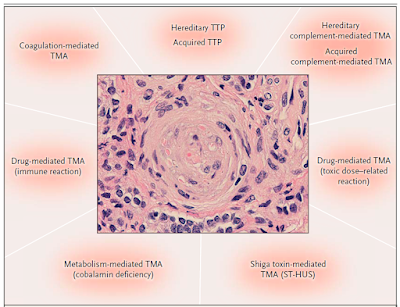
TMA or better called “endothelial injury”- such as ADAMTS13 mediated, complement
mediated, Drug induced ( immune vs toxic), Shiga toxin mediated, metabolism
mediated, coagulation mediated and so forth. This figure is from the classic NEJM article by George et al in 2014.