Monday, July 7, 2014
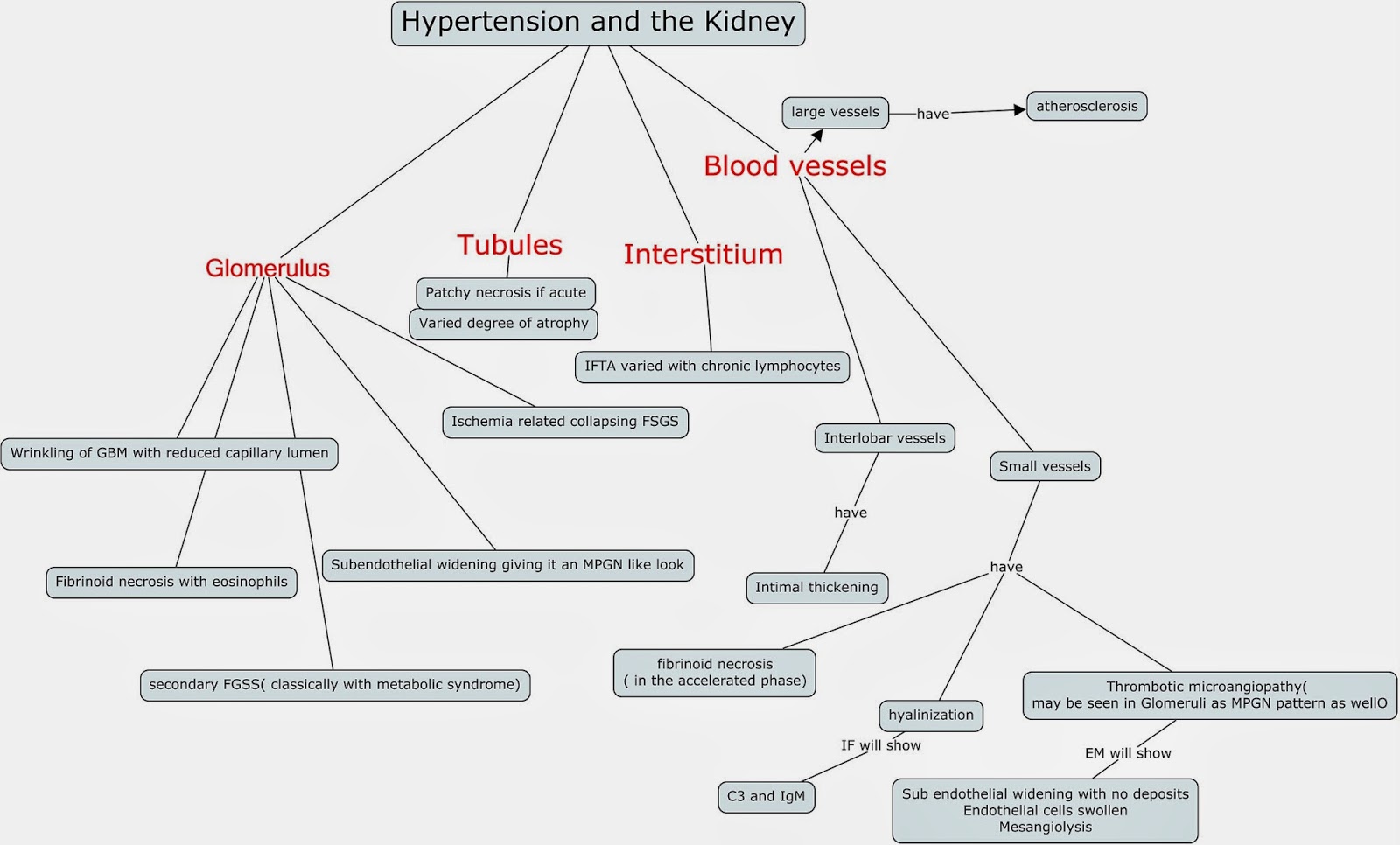
Concept Map: Pathology findings in Hypertension and the Kidney
The different parts of the kidney have classic findings due to HTN. Classically, the glomeruli and vessels are the major targets. The major "disease" categories that are associated with HTN findings are:
FSGS pattern of injury( due to the chronic changes)
Collapsing FSGS form of injury ( due to ischemic injury)
MPGN pattern of injury that is TMA ( negative IF and no deposits)
Here is a good reference
http://www.ncbi.nlm.nih.gov/pubmed/18408477
Labels:
concept maps,
Hypertension,
pathology
Friday, June 27, 2014
Topic Discussion: Diabetic Nephropathy Pathology Classification
As
we all know that if there is a clinical history of DMII in someone with
proteinuria or renal disease, DM nephropathy
is always on the differential on what one might find on the kidney biopsy.
Take a look at this recentpathology classification of DMII nephropathy. It starts off at classifying it in terms of mesangial expansion and leading to the classic KW lesions. It reminds you of a lupus classification but in this case, its more progressive. This article in JASN published many years ago has been the proposal paper. I am hoping validation studies are underway to confirm this. Does this help us as clinicians? Or is it more for pathologists to have a better handle on how to diagnose DM on kidney biopsy as presentations can be so variable. Looking at the classification, I think the diagnosis of DM nephropathy will increase. Class I is more of just EM changes of GBM thickening. IIa and IIb are the classic mesangial expansion. The KW lesion is the cornerstone of Class III and IV is bad advanced diabetic glomerulosclerosis.
|
Class
|
Description
|
Inclusion Criteria
|
|
I
|
Mild or nonspecific LM
changes and EM-proven GBM thickening
|
Biopsy does not meet any
of the criteria mentioned below for class II, III, or IV
|
|
GBM > 395 nm in
female and >430 nm in male individuals 9 years of age and oldera
|
||
|
IIa
|
Mild mesangial expansion
|
Biopsy does not meet
criteria for class III or IV
|
|
Mild mesangial expansion
in >25% of the observed mesangium
|
||
|
IIb
|
Severe mesangial
expansion
|
Biopsy does not meet
criteria for class III or IV
|
|
Severe mesangial
expansion in >25% of the observed mesangium
|
||
|
III
|
Nodular sclerosis
(Kimmelstiel–Wilson lesion)
|
Biopsy does not meet
criteria for class IV
|
|
At least one convincing
Kimmelstiel–Wilson lesion
|
||
|
IV
|
Advanced diabetic
glomerulosclerosis
|
Global glomerular
sclerosis in >50% of glomeruli
|
|
Lesions from classes I
through III
|
Table from JASN paper from above.
What we learned in medical school was one of the secondary causes
of membranous GN pattern on injury was diabetes. Classically, in practice I have rarely seen
that. We classically see the mesangial changes and KW lesions. The thickening
and EBM changes can appear like Membranous GN on biopsy but there are no classic
deposits and there is no mention of those changes on the above classification
scheme. Membranous GN that is primary in
nature can likely to co-exist with DM nephropathy. Others
have mentioned this as well on websites. There is only one association I
found of this in the literature and that was related to potential insulin deposits
that were seen in some patients with DM that developed membranous GN and that
suggestive of the pathogenetic role in the presentation.
Diabetes rarely presents as a membranous pattern. The above mentioned patterns are
the most common presentations of DMII.
Labels:
diabetes,
pathology,
topic discussions
Wednesday, June 25, 2014
TOPIC DISCUSSION: CONGESTIVE RENAL FAILURE

Concept of congestive renal failure is slowly emerging again
in regards to congestive heart failure (CHF) related renal disease. The classic teaching was that renal
failure in CHF is related to poor forward flow. That would make sense is the
MAP is low and SBP is low and you are in a shock state. That constitutes on 5%
of the CHF patients that present with cardiogenic shock. The rest are stable
CHF with AKI or CKD. What is then the patho-physiology?
Well, as this article nicely puts it – it’s
congestive renal failure. It’s renal
venous congestion. Studies have shown that CVP>24 are more likely to lead to
AKI then CVP <8. It’s not the
SBP. This renal venous congestion and
HTN is likely from parenchymal congestion within the confines of the non
distensible kidney capsule. This would
then raise the renal interstitial pressure and would lead to affect the entire
capillaries and tubules leading to tissue hypoxia. The effect on tubules and capillaries occurs most
at venous pressure >15mm Hg. The best measure of this is intra-abdominal
pressures done via bladder pressures.
Intra abdominal HTN might be the best marker for how bad the kidneys
might be congested and about to have a renal tamponade( as Jai Radhakrishnan or a cardio-nephroligst would say it).
Besides the above mechanisms, the active inflammatory
mileau, endothelin release, reactive oxidative species release might also be
contributing to AKI.
In other words, CHF leads to venous congestion and decreased
cardiac output, but the former plays a
bigger role in AKI then the later. This
below table helps summarize a quick and dirty way of looking at CHF and how to
manage it in the setting of AKI based on low perfusion and or congestion at
rest.
Congestion At Rest
No
|
Yes
|
|
No
|
Warm and Dry( good job)
|
Warm and Wet( most common – optimize diuretics and/or
add other agents UF/tolvaptan)
|
Yes
|
Cold and Dry( r/o over diuresis)
|
Cold and Wet( Most dangerous and requiring
LVAD/transplant)
|
Low Perfusion at Rest
image source: http://ahmedshokry.files.wordpress.com/2012/04/hf.jpg
Labels:
cardiology,
icu nephrology,
topic discussions
Monday, June 23, 2014
AKI- when do we use CRRT?
Many
studies have looked at this question but with no real answer that was put
forth. In a recent 2013 AKI ( European
best practice position statement) on KDIGO guidelines on RRT, they mention the
following:
##Use
of CRRT or IHD as complementary therapies in AKI( Grade 1A)
##Using
CRRT or SLED than IHD for hemodynamically unstable patients( no grade given)
##Using
CRRT rather than IHD for AKI associated with brain injury or increased
intracranial pressure ( grade 2D). – This
is based on limited
evidence poor quality studies. Intermittent modes of renal replacement
therapy have been shown to cause an increase in intracranial pressure in
susceptible patients, including those with acute liver failure and cerebral
edema from trauma or post neurosurgery. Such changes are due to the combination
of adverse effects on cerebral oxygen delivery and/or cerebral perfusion
pressure and the generation of an osmotic gradient between plasma and cerebral
tissues. Compared with standard IHD, CRRT
provides an effective therapy in terms of solute clearance, coupled with
improved cardiovascular and intracranial stability. The disadvantage of CRRT is
that anticoagulation may be required, and anticoagulants with systemic effects
may provoke intracerebral hemorrhage. CRRT
also has been shown to help in case reports to decrease
intra cranial HTN.
##The
dose of CRRT to be delivered an effluent volume of 20-25ml/kg/h for post
dilution CRRT in AKI( Grade 1A)
##Medication
adjustment based on clearance needs to be taken into account.
Labels:
acute kidney injury,
icu nephrology
Wednesday, June 18, 2014
IgA Nephropathy and Minimal Change Disease?- a potential association
IgA nephropathy can take many variants. Classically, it can
present as the nephritic syndrome but can be just benign hematuria with no
other complaints. Sometimes it can be aggressive with crescents and or
TMA. Proteinuria usually suggest a bad
prognostic marker in IgA nephropathy.
Sudden onset proteinuria might suggest a dual glomerular process or IgA
nephropathy with a minimal change disease variant. A recent series of cases have been described
in CJASN. A retrospective review of pathology cases in
the Columbia Univ path database revealed 17 such cases. Most had normal creatinine, proteinuria was
over 8g for average and biopsy showed co dominant IgA with mesangial deposits
and MCD. 14/17 patients got complete
remission with steroids and additional agents.
Another case presented in this case report.
Tuesday, June 3, 2014
IN THE NEWS: Transplantation and risk of death from malignancies
A recent
article in KI looked at death from malignancy after renal transplantation.
Some key
findings:
Single center
study in England looking from 2001-2012
18% deaths were from malignancy(lymphoma>lung>renal and others)
Age and gender stratified malignancy related mortality risk difference was higher than in transplant compared to general population.
Risk factors: pre transplant history of malignancy, DDRT and age.
Lung cancer was the most common cause of malignancy death in men and lymphoma in women.
There was no significant difference in the rate of cancer-related death or location of cancer with ethnicity in our cohort, although a trend was observed toward less overall malignancy-related death in non-whites versus whites.
18% deaths were from malignancy(lymphoma>lung>renal and others)
Age and gender stratified malignancy related mortality risk difference was higher than in transplant compared to general population.
Risk factors: pre transplant history of malignancy, DDRT and age.
Lung cancer was the most common cause of malignancy death in men and lymphoma in women.
There was no significant difference in the rate of cancer-related death or location of cancer with ethnicity in our cohort, although a trend was observed toward less overall malignancy-related death in non-whites versus whites.
Not surprising to find these findings given the nature of immunosuppressive medications and prior hx of malignancies.
Labels:
cancer,
In The News,
kidney transplantation,
onco nephrology
Monday, June 2, 2014
IN THE NEWS: CKD and Renal Cancer Risk?
A recent study in JASN
found that those with stage 3 CKD were 39% to 100% more likely to be diagnosed
with renal cell cancer over 5 years than people with Stage 2 CKD. In addition, urothelial cancer was also more
common in this group. Risk was greatest for clear cell renal cancer. No
association was found with colon, lung and breast cancer or other cancers. This
is the largest outcome study in a single health care system in the US looking
at cancer risk and CKD. As GFR declined,
the risk of urothelial and bladder cancer increased.
A recent study in AJKD had also shown similar findings.
One
thing to keep in mind in the large data base studies is the variables being
adjusted for. It appears that the researchers adjusted for many of the classic
cancer associated variables. Cause was
CKD was not well discussed in the manuscript. Cause can make a difference.
Glomerular diseases with “ net immunosuppressive” exposure such as SLE patients
with CKD are more likely to have exposure to cyclophosphamide, CNIs and other medications
making them more prone to malignancies than perhaps diabetic CKDs. They did adjust for proteinuria and hematuria
and perhaps that can serve as a best surrogate as a cause.
Where
do we go from here?
Should
we be screening for renal cell with yearly ultrasounds on everyone with
CKD? Would it make a big difference?
Screening for cancer in CKD has been a black box and perhaps studies like these
shed some light on the type of cancers we should be more alerted to than the
classic screening done in general population.
Labels:
CKD and ESRD,
onco nephrology,
renal cell cancer
Subscribe to:
Posts (Atom)