Tuesday, January 28, 2020
Concept map: Copeptin in Natremias
The above figure summarizes the best data on use of serum copeptin level for diagnosis of diabetes inspidus and primary polydipsia. Copeptin derives from the precursor protein of AVP and has been correlated well with AVP production
What about in cases of increased ADH- such as SIADH? Data on that is poor and only one large study of >200+ patients showed that in hypovolemic hyponatremia ( appropriate ADH), the copeptin levels were >84pmol/L ( spec 90%, sens 23%) and SIADH fell in the 10-30pmol/L categories( not helping much) and hypervolemic and diuretic induced fell in 30-65pmol/L category. Use of this test is currently not recommended in diagnosis of increased AVP production disorders.
Finally in patients with nephrogenic syndrome of inappropriate anti diuresis, copeptin levels were are low or suppressed.
This article is an excellent summary of the use of copeptin in Na related disorders
https://www.ncbi.nlm.nih.gov/pmc/articles/PMC6850413/
Labels:
concept maps,
copeptin,
natremia
Monday, January 20, 2020
Topic Discussion: Hypertension and TMA- chicken or the egg?
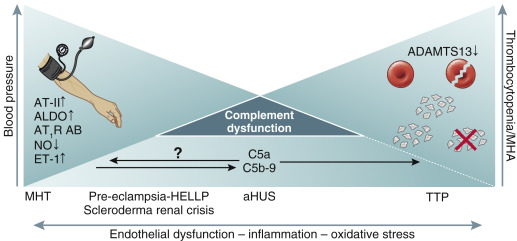
A recent discussion on twitter and ASN Communities has sparked this age old battle if HTN related TMA exists? Some believe that TMA is the initial insult and that leads to endothelial damage and HTN is a symptom and not the disease. Some believe that HTN is the start - leading to sheer stress and endothelial damage and in severe cases-- TMA
Check out the amazing twitter discussion by TMA experts on this topic.
What i found was this amazing image

As one can see in this image- with some data existing on this - that malignant HTN can lead to endothelial dysfunction and some complement activation but not as severe as aHUS.
So if HTN does cause TMA, how does one distinguish that from a complement mediated TMA or aHUS? What if we are missing a mutation or an antibody that we haven't discovered.
1) Kidney biopsy cannot distinguish HTN induced TMA from complement mediated TMA 2) C3 being low is more valuable for an over active complement cascade compared to C5b-9 as even HTN can cause that to be elevated
3)) Doing a fundus exam can help significantly- there is no value in genetic testing in grade 3/4 retinopathy and especially with DBP>130mm Hg 4) No value in genetic testing in those that have a good response to bp control and eventually stabilized kidney function.
5) Ongoing TMA despite bp control and recovering of renal function- likely is then not HTN mediated and additional complement testing should be done.
Does having chronic or acute hypertension cause endothelial damage and TMA or does TMA cause endothelial damage and HTN as a result? @purvasharma821 @KidneyKhanin @VBijol @renalmyeloma @NephRodby @GlassockJ— Kenar Jhaveri (@kdjhaveri) January 15, 2020
Check out the amazing twitter discussion by TMA experts on this topic.
What i found was this amazing image
As one can see in this image- with some data existing on this - that malignant HTN can lead to endothelial dysfunction and some complement activation but not as severe as aHUS.
So if HTN does cause TMA, how does one distinguish that from a complement mediated TMA or aHUS? What if we are missing a mutation or an antibody that we haven't discovered.
1) Kidney biopsy cannot distinguish HTN induced TMA from complement mediated TMA 2) C3 being low is more valuable for an over active complement cascade compared to C5b-9 as even HTN can cause that to be elevated
3)) Doing a fundus exam can help significantly- there is no value in genetic testing in grade 3/4 retinopathy and especially with DBP>130mm Hg 4) No value in genetic testing in those that have a good response to bp control and eventually stabilized kidney function.
5) Ongoing TMA despite bp control and recovering of renal function- likely is then not HTN mediated and additional complement testing should be done.
Tuesday, December 31, 2019
Concept map: Immune check point inhibitors and the Kidney
This is the summary of the renal effects of ICI therapy on the kidney ( as of Dec 2019). This might change as we learn more and more about these agents.
Labels:
concept maps,
immunology,
onco nephrology
Thursday, December 19, 2019
Coming in May of 2020- A glomerular disease conference at Northwell
An
Update on Glomerular Diseases, 2020
#northwellGN2020
Saturday, May 2, 2020
7:30am to 6:00pm
North Shore
University Hospital
300 Community
Drive
Manhasset,
New York 11030
@hofstrakidney
Registration information to follow in few weeks
|
||||
|
||||
8:00AM Introduction Kenar D. Jhaveri, MD
8:15AM Membranous
Nephropathy in the PLA2R era Richard
Glassock, MD,
9:00 AM Thrombotic Microangiopathies, A novel
approach, Vanesa Bijol, MD
9:45 AM ANCA and Anti GBM disease in 2020- some old and
some new, Duruvu Geetha, MBBS
10:15AM Break
and exhibits
10:30 AM SGLT-2 inhibitors, diabetic nephropathy and
beyond!! Nupur N Uppal, MD
11:10 AM Treating the right clone- Paraproteinemias Kenar D. Jhaveri, MD
12:00 PM Lunch
and exhibits
1:00 PM MPGN, C3GN..a paradigm shift. Shikha Wadhwani, MD,MS
1:40 PM Drugs, Chemo, Toxins—and the glomeruli. Hitesh H
Shah, MD
2:15 PM IgA Nephropathy- treat or not to treat. Gerald Appel, MD
3:00 PM Podocytopathies, Clinical approach and treatment. Purva Sharma, MD
3:40 PM Treatment of Refractory Lupus Nephritis, Brad H. Rovin, MD
4:15 PM Break
and Exhibit
4:30 PM Did you find my gene for the glomerular
disease??. Barry I. Freedman, MD
5:00PM Case Studies in Glomerular diseases, Vanesa Bijol, MD Purva Sharma ,MD and Kenar D.
Jhaveri,MD
Labels:
conference,
education,
glomerular diseases
Saturday, December 14, 2019
Tuesday, November 26, 2019
Concept Map: Thiazide induced hyponatremias(TAH)
We see this form of hyponatremia in several cases, but recently there has been some newer findings on the mechanisms of TAH(*). In one study published in JCI in 2017, Ware et al showed that there is a subset of patients with a genetic baseline( SLCO2A1 mutation) decrease in prostaglandin(PGE) transport activity which then becomes a risk factor for TAH. So these patients have increased urinary PGE2 and low AVP levels leading to a pure "nephrogenic" cause of tubular water absorption and dilution hyponatremia. PGE2 is critical in insertion and removal of AQP2 channels in the apical membrane. Increased PGE2 signaling leads to insertion of AQP2 channels into membrane and increase water absorption in an ADH independent manner. This is fascinating. Perhaps then mechanism in NSAIDS as well?
Check out this amazing review in AJKD on this topic.
Labels:
concept maps,
diuretics,
hyponatremia,
natremias
Friday, November 22, 2019
Topic Discussion: Zytiga (Abiraterone) induced hypernatremia, and HTN
Zytiga (Abiraterone)
is a hormonal chemotherapy agent used to treat prostate cancer. It selectively and irreversibly inhibits
CYP17 (17 alpha-hydroxylase/C17,20-lyase), an enzyme required for androgen
biosynthesis which is expressed in testicular, adrenal, and prostatic tumor
tissues. Inhibits the formation of the testosterone precursors dehydroepiandrosterone
(DHEA) and androstenedione.
Interestingly. it has
a high rate of hypernatremia as a known renal complication. In several studies,
hypernatremia (33%), hypokalemia (17% to 30%) were reported as known
complications. Why? It is postulated that it can increase mineralocorticoids due
to CYP17 inhibition may result in hypertension, hypokalemia, and fluid
retention (including grade 3 and 4 events) and perhaps some component of
hypernatremia as well- almost like a Cushing's state. Per package insert, concomitant administration
with corticosteroids reduces the incidence and severity of these adverse events.
In the LATITUDE trial, which
used prednisone 5 mg daily in combination with 1000 mg abiraterone acetate
daily, grades 3-4 hypokalemia were detected in 10% of patients on the zytiga arm and 1% of patients on the placebo arm, grades 3-4 hypertension were
observed in 20% of patients on the zytiga arm and 10% of patients on the
placebo arm. Grades 3-4 fluid retention occurred in 1% of patients each arm.
It is
recommended that patients get monitored for hypertension, hypokalemia, and
fluid retention at least once a month. Treatment of hypertension is recommended, choice
of drug is not defined.
This is an
interesting toxicity that as nephrologist seeing prostate cancer with CKD and
perhaps new onset hypertension, hypokalemia or hypernatremia should consider in the
differential diagnosis.
Labels:
electrolytes,
Hypertension,
natremia,
onco nephrology,
topic discussions,
zytiga
Subscribe to:
Posts (Atom)