Showing posts with label contrast agent. Show all posts

Wednesday, April 17, 2019

Topic Discussion: Newer Gadolinium agents and risk of NSF? is it extinct?


Gadolinium is known to have an association with Nephrogenic Systemic Fibrosis(NSF). The first case of this was described in Yale and published in Lancet. A potential link between NSF and the application of gadolinium-based contrast agents (GBCAs) was first described by Grobner et al in 2006. The risk of gadolinium based contrast agents to trigger NSF seems to be related to the stability of the agent. Thus, nonionic linear gadolinium based contrast agents are more likely to trigger NSF than ionic linear agents both of which are distinctly more likely to trigger the disease than the macrocyclic agents in patients with reduced renal function. Gadobutrol (Gadovist, Gadavist) is a second-generation nonionic, multipurpose, extracellular, macrocyclic gadolinium based contrast agent provided in a 1 molar concentration. As a macrocyclic contrast agent, gadobutrol provides high chelate stability with substantially less—if any—in vivo release of Gd ions as opposed to linear gadolinium (old school agents). The release of gadolinium ions has been linked to an increased risk of NSF in patients with impaired renal function. The highest prevalence of NSF was associated with Omniscan, Optimark as most of these have a weak binding of gadolinium to the chelate. 
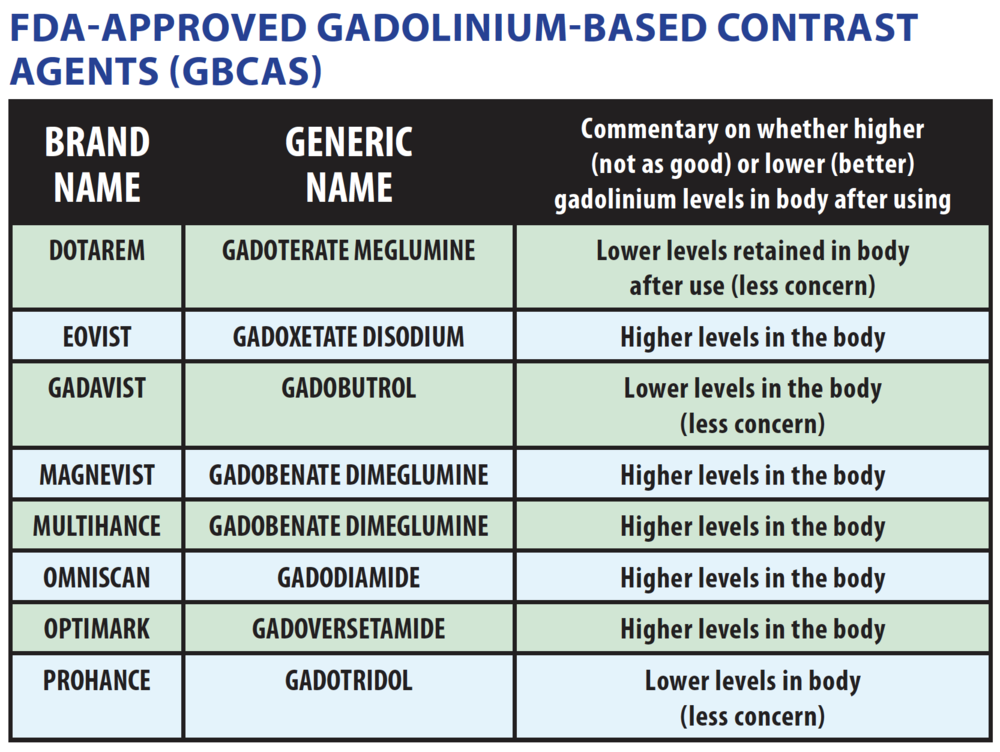


Image result for new gadolinium agents and NSF

So are these safer? A large study published in 2017 was a prospective, international, multicenter, open-label study in 55 centers. Patients with moderate to severe renal impairment scheduled for any gadobutrol-enhanced MRI were included. All patients received a single intravenous bolus injection of gadobutrol at a dose of 0.1 mmol/kg body weight. The primary target variable was the number of patients who develop NSF within a 2-year follow-up period. A total of 908 patients were enrolled, including 586 with moderate and 284 with severe renal impairment who are at highest risk for developing NSF. Overall, 184 patients (20.3%) underwent further contrast-enhanced MRI with other gadolinium-based contrast agents within the 2-year follow-up. No patient developed symptoms conclusive of NSF.

Another study by Lauenstein et al, investigated gadoxetate disodium in 357 patients. No case of NSF was recorded. Another recent study by Amet et al investigated the risk of gadoteric acid in 255 patients on dialysis with no findings of NSF. In addition, Soulez et al reported 2 prospective 2-year studies in 534 patients with either stage 3 chronic kidney disease (CKD) or stage 4 to 5 CKD. No signs or symptoms of NSF were reported after administration of gadobenate dimeglumine or gadoteridol. Smorodinsky et al retrospectively evaluated 1167 patients with chronic liver disease where 72% also had some degree of renal insufficiency. They did not report any case of NSF.

A recent Canadian society published their analysis and concluded that “In patients with AKI and category G4 and G5 CKD (eGFR < 30 mL/min/1.73 m2) and in dialysis-dependent patients who require Gadolinium based contrast agentss-enhanced MRI, they can be administered with exceedingly low risk of causing NSF when using macrocyclic agents and newer linear agents at routine doses.”

Here are images online from medscape education that are very useful on this matter.


A lot of centers in the world are now carrying and using Gadovist and perhaps we won’t see any NSF? 

Thursday, March 9, 2017

AMACING trial: Fluids vs No fluids for Contrast Nephropathy prevention: A visualabstract


An animated #visualabstract for the recent AMACING study published in Lancet 2017 that was a randomized controlled trial for prevention of CIN with IV fluids vs placebo.

Below is a non animated version of the abstract


Tuesday, February 21, 2017

In the NEWS: Death of Contrast induced Nephropathy

If you were a twitter follower: I am sure you saw this post by Dr Topf on


The article just published in Lancet proves in a RCT that fluids don't help in high risk patients in preventing contrast nephropathy (CIN).

http://www.sciencedirect.com/science/article/pii/S0140673617300570

This comes after many recent papers that have questioned the very existence of this entity. While it exists, perhaps the incidence has been over sized.  This was nicely shown by Chertow's team in 2016
https://www.ncbi.nlm.nih.gov/pubmed/27688297

Bigger questions will arise as we move forward in the era of Cardiac-Nephrology. Discussions with cardiologists are going to be essential. While the Lancet paper will get it's share of supporters and opposers, the debate will continue as now the question has arisen- does CIN even exist? Is this the death of CIN?


1. Does intra-arterial vs intra-venous contrast make the kidneys worse?
2. Does giving NAC matter?
3. Does giving IV fluids matter?- pre and post and or based on wedge pressure
4. Does holding ACEi/ARB matter?
5. Does holding diuretics matter?- Might so if they are planning to do a TAVR.

Tough road ahead as - what can the Nephrologist do then for these patients? I guess - Nothing! and perhaps doing nothing might be beneficial to the patient. We shall see!

Friday, July 31, 2015

Journal Club: CAPTAIN TRIAL: ACEI /ARB pre cardiac cath: Hold or not to hold


There is unclear evidence on holding ACEi/ ARB prior to coronary angiography reduces contrast induced nephropathy (CIN). The CAPTAIN trail just published in the American Heart Journal was a randomized trial to investigate whether holding ACEi/ ARB prior to cardiac catheterization reduces the incidence of contrast-induced AKI in patients with chronic kidney disease (CKD).


Some key points:
Total of 208 patients underwent randomization over 6 years with CKD as defined - creatinine >1.7mg/dl w/in 3 months before  cardiac catheterization and/or serum creatinine > 1.5 mg/dl w/in 1 week before cardiac catheterization
Primary outcome: incidence of AKI defined as an absolute rise in Scr of >0.5 mg/dl from baseline and/or a relative rise in Scr of > 25% compared with baseline at any time between 48 and 96 hrs post-cardiac catheterization.
Secondary outcome: absolute difference in post-procedure creatinine compared with baseline creatinine
Safety outcome was a composite of CHF or hypertension after the procedure
Results of the study demonstrate that in patients with CKD, holding compared w/ continuing ACEi/ARB prior to cardiac catheterization, with-holding ACEi/ARB resulted in a:
1.       Non-significant reduction in contrast-induced AKI
2.       Significant reduction in post-procedural rise of creatinine.
3.       Study demonstrated a strong trend toward improved clinical outcomes when ACEi/ARB was held before angiography.
4.       No adverse events were reported in the hold ACEi/ARB group
5.       Safety: no rise in CHF or HTN with holding ACEi/ARB therapy

This randomized trial does suggest that in CKD patients, it might be beneficial to hold the ACEI/ARB pre cardiac cath for some potential benefit.  A larger N would have perhaps been important to do to get a better sense of this protective effect. A multi center study would have been useful as well. 

Wednesday, January 2, 2013

IV contrast medium and ESRD

Radiologist: Please arrange for nephrology to comment on allowing us to give IV contrast to this dialysis patient. Right after the CT with IV contrast, dialysis has to be arranged.
Nephrology fellow: Why? the patient is anuric and what's the data on volume overload and needing of emergent dialysis after IV contrast dye.
Radiologist: Hmmm, good question. Lets look at it together.
Nephrology fellow: Look at this, its from the American College of Radiology Drug and Contrast Media 2012 update. 
"Renal Dialysis Patients and the Use of Iodinated Contrast Medium"
Patients with anuric end-stage chronic kidney disease can receive intravascular iodinated contrast medium without risk of further renal damage because their kidneys are no longer functioning. However, there is a theoretical risk of converting an oliguric dialysis patient to an anuric dialysis patient by exposing him or her to intravascular iodinated contrast medium. This remains speculative, as there are no conclusive outcome data in oliguric dialysis patients in this setting.
Patients receiving dialysis are also at theoretical risk from the osmotic load imposed by intravascular iodinated contrast medium because they cannot clear the excess intravascular volume. This osmotic load can theoretically result in pulmonary edema and anasarca. To mitigate this possible risk, contrast medium dosing should be as low as necessary to achieve a diagnostic result (as in all patients). However, complications were not observed in a study of dialysis patients who received intravascular nonionic iodinated contrast medium, though the number of patients was small.
Contrast agents are not protein-bound, have relatively low molecular weights, and are readily cleared by dialysis. Unless an unusually large volume of contrast medium is administered or there is substantial underlying cardiac dysfunction, there is no need for urgent dialysis after intravascular iodinated contrast medium administration.

Radiologist: I guess we rest that case.
Nephrology fellow: The guidelines by ACR have good information on MRI and CT scan and AKI and ESRD patients.

Monday, December 17, 2012

IN THE NEWS: Contrast Nephropathy

Preventing contrast nephropathy has always been a research topic. From anti oxidants to hydration to dialysis all have been suggested. Hydration likely to be the only winner thus far.
Two recent studies need to be highlighted that have come out in the cardiology literature.

1.  Tamai et al from Japan studied a moderate size subgroup of patients with significantly high doses of bircarbonate infusion( close to 800meq/L) compared to standard bicarbonate infusions(160meq/L) pre cardiac cath at a rate of 3ml/kg/h for one hour. As expected urine pH was higher in the first group but statistical significant rate of decline of contrast induced nephrolopathy as well in that group. Potassium values didn't change much. 48 Hour GFR change was much more in the standard bicarbonate group. Interestingly, baseline renal function was around 1.3-1.4mg/dl with some difference in both groups making this study weaker. Also, while initial Na concentrations were similar, wonder what 24 hour Na levels were in these cases. Interesting study to bring back alkalization as a potential prevention for contrast nephropathy.

2. Marenzi et al show that fluids with match diuresis might prevent contrast induced nephropathy compared to standard fluid therapy The MYTHOS study looked at 250ml Normal Saline bolus followed by furosemide to keep urine output >300cc/h and then do the cardiac procedure versus a standard fluid infusion model. Contrast induced nephropathy rates were much lower in the case where urine output was high. Another interesting concept and study to look at this problem

Both studies: single centers, small studies, many limitations. Have a look but they might catch on in the cardiology world and we might be seeing some of this happening at our centers.

Thursday, June 16, 2011

IN THE NEWS: The ACT trial

ACT trial is the Acetylcysteine for the prevention of Contrast Induced nephropathy trial. This is the largest randomized trial to date on this concept. Cardiologists and Nephrologists are using acetylcysteine( mucomyst) to prevent contrast nephropathy for the past decade with no real evidence if it really does any benefit. Clearly, there is no harm. But what is the data?
At the recent cardiology meetings at AHA 2010, the primary investigators of this trial showed that the risk of contrast induced nephropathy in patients undergoing coronary or vascular angiography was not reduced using mucomyst.  Close to 2300 patients in a single country were randomized from 2008-2010 and the treatment dose was 1200mg BID for 2 dose prior and 2 doses after procedure.  This was compared to placebo.
There was patients with CKD included close to 15% or so in each arm.  The primary endpoint was Contrast nephropathy as defined by >25% elevation in crt above baseline.  Secondary endpoint was mortality and need for dialysis and side effects. The final conclusions were that the mucomyst does not reduce short term risk of contrast nephropathy and nor did it meet any of the secondary outcomes.
Final publication probably is on its way.  This is probably a final blow on using acetylcysteine in prevention of contrast. At this point, it seems that it was nor harming nor benefiting.  Seems like a well designed study keeping all renal parameters in mind. Not sure if cystatin C was used at all or other novel renal parameters to pick up some minor injuries.  Fluids might be the only alternative. Also, till the paper comes out, we can't know what other causes of renal injury were ruled out.
Comparing bicarbonate based vs normal saline base at a large scale might be necessary as well and might be underway.

A podcast about this can be heard at

A peak at the study can be found at:


All Posts

Search This Blog